
Monthly Newsletter
CBF Highlights California’s Life Science Impact & World Hepatitis Day
July 2026
The Life Science Industry In California Generates $394 Billion Annually & Supports 1.08 Million Total Jobs
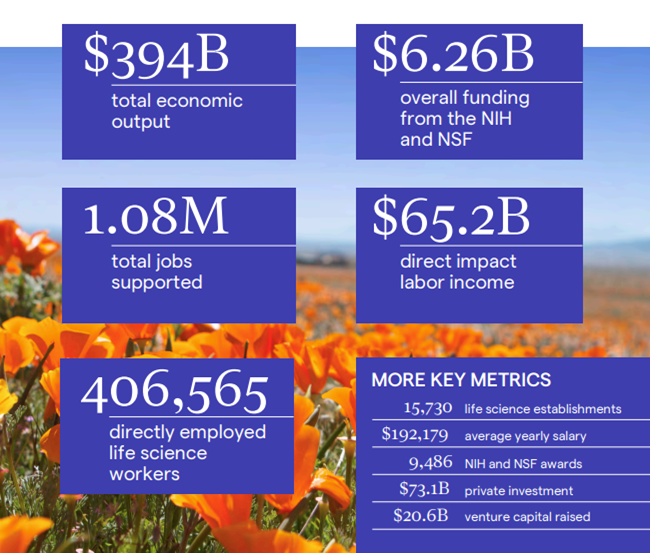
Biocom California, the advocate for life sciences in California, released a new report – 2026 Life Science Economic Impact Report – which outlines key findings about the state’s life science industry, including information on economic, demographic, investment and industry performance data. The report underscores the significant contributions of the life science industry across California and in specific regions.
Among its most important findings, California’s life science industry:
- Includes 15,730 life science establishments
- Generates $394 billion to the state’s economy
- Supports 1.08 million jobs (406,000 direct jobs/674,000 indirect jobs)
- Provides an annual average wage to employees of over $192,179
- Increases total labor income by $126.9 billion per year
- Attracted $73.1 billion in private investment including $20.6 billion in venture capital
- Received $6.26 billion in federal research funding (NIH & NSF) with nearly 9,500 grants awarded
The report also highlights emerging trends shaping the future of the industry, including the growing use of artificial intelligence in drug discovery and manufacturing, expanded domestic manufacturing capacity, and changing investment and licensing strategies. Life science manufacturing alone now employs more than 143,000 Californians, representing more than one-third of all life science jobs in the state.
Beyond the data, the report features stories that demonstrate how California companies are translating scientific discoveries into real-world solutions—from breakthrough therapies and diagnostics to advanced manufacturing technologies. These innovations not only improve patient outcomes but also strengthen local communities through new businesses, skilled jobs, and continued economic growth.
Together, the findings reinforce California’s leadership in life science innovation and the critical role the industry plays in advancing health while driving the state’s economy.
To explore the complete report and regional data, visit Biocom’s 2026 Life Science Economic Impact Report.
World Hepatitis Day Highlights Progress Toward Eliminating a Global Health Threat
Each year on July 28, World Hepatitis Day raises awareness of viral hepatitis and encourages prevention, testing and treatment. The observance also honors the birthday of Nobel Prize-winning scientist Dr. Baruch Blumberg, whose discovery of the hepatitis B virus led to the development of the first hepatitis B vaccine.
This year’s global campaign theme is “Hepatitis: Let’s break it down”, focusing on eliminating testing and treatment barriers, reducing public stigma, and turning proven science into action to meet the 2030 elimination targets.
Viral hepatitis affects the liver and includes five main types—hepatitis A, B, C, D and E. Hepatitis A and E are typically spread through contaminated food or water and usually cause short-term illness. Hepatitis B, C and D can become chronic infections, increasing the risk of cirrhosis and liver cancer. Hepatitis D occurs only in people already infected with hepatitis B and is considered the most severe form of viral hepatitis.
According to World Health Organization, nearly 300 million people are living with chronic hepatitis B or C which claims approximately 1.3 million lives each year. In the United States, the American Liver Foundation reports that millions of people are living with chronic hepatitis B or C, many of whom remain undiagnosed, making screening and early treatment essential.
Biotechnology has transformed the outlook for patients with viral hepatitis. Safe and effective vaccines have dramatically reduced hepatitis A and B infections, while direct-acting antiviral medicines can now cure more than 95% of hepatitis C infections in as little as 8 to 12 weeks.
California-based Gilead Sciences helped pioneer this revolution with breakthrough hepatitis C therapies that made cure a reality for millions of patients worldwide. More recently, Gilead received FDA approval for the first treatment for chronic hepatitis D, offering new hope for patients with this rare but serious disease. Researchers are also making significant progress toward a functional cure for chronic hepatitis B, with several promising therapies now in late-stage clinical development.
This World Hepatitis Day, continued investment in research, innovation and equitable access to testing and treatment will be essential to achieving the global goal of eliminating viral hepatitis as a public health threat by 2030.
Stay informed on the latest news and trends on the economic and health benefits of this industry by visiting CABiotech.org
If you have any questions about hosting informational briefings for your colleagues serving in the legislature, contact California Biotechnology Foundation Executive Director Patty Cooper at (916)764-2434 or [email protected].